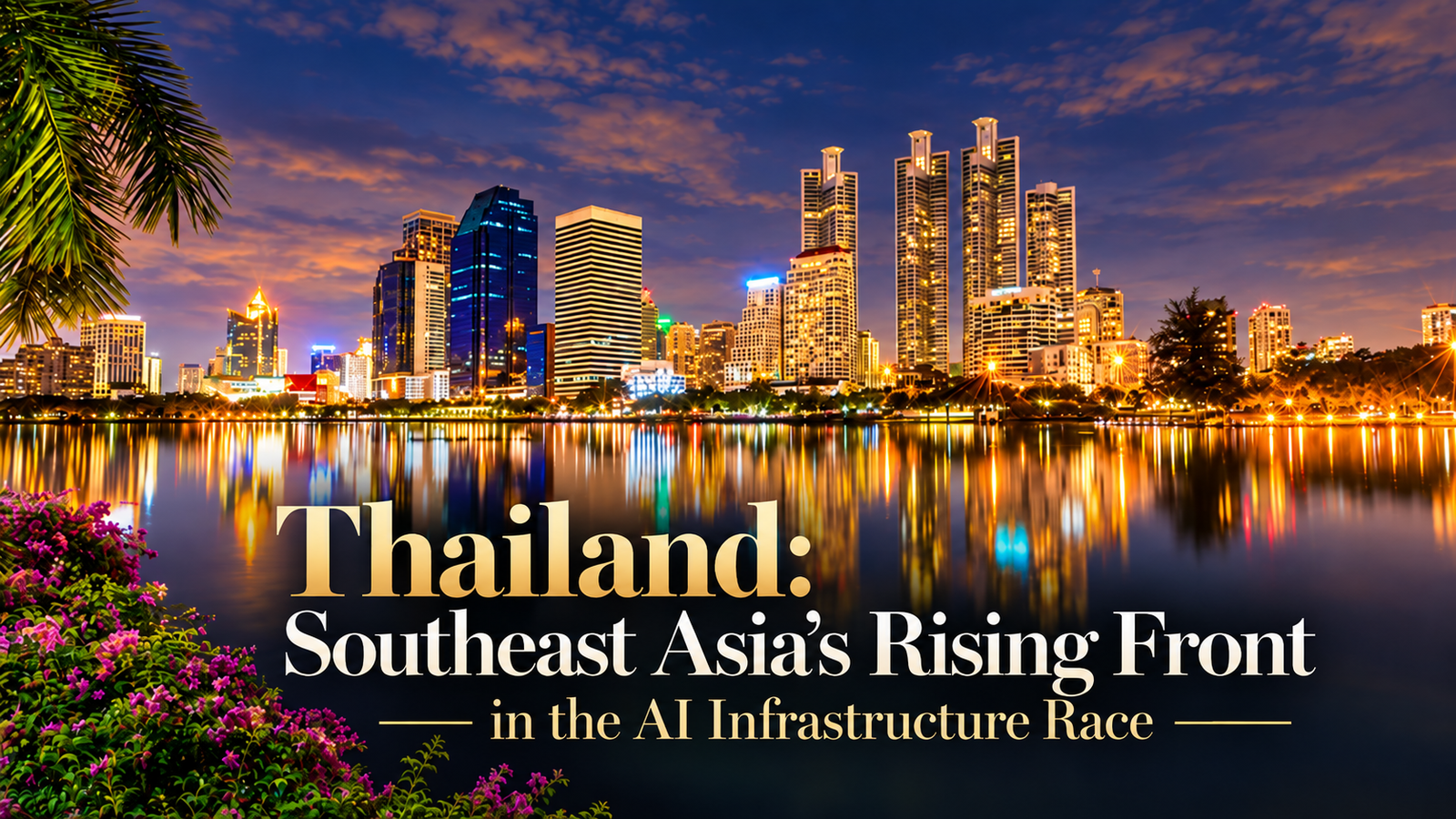
While America’s domestic infrastructure, energy dominance, and manufacturing base must remain our absolute priority, the global AI infrastructure race requires clear strategic foresight on multiple fronts. Securing advantageous positions abroad is not a distraction from American strength; it is an essential extension of it. If you want to see where one of the most important emerging battlegrounds is accelerating, look at Thailand.
As Singapore, the long-standing king of Southeast Asian tech, hits hard limits on power and land, major hyperscalers like Google, AWS, and Microsoft are shifting north. Thailand’s Board of Investment (BOI) saw 36 data center project applications in 2025 alone totaling over 728 billion baht (approximately $23 billion), with approvals continuing into early 2026. This is rapidly positioning Thailand as a major hyperscale hub in ASEAN.
This isn’t just cloud expansion. It is a structural move in a larger strategic contest.
The domestic US market must be our top priority. Our infrastructure, energy dominance, and manufacturing are the bedrock of our national security. However, we cannot treat the United States as the only front in this war.
In the global war for AI dominance, every gigawatt of grid capacity and every skilled operator American companies lock down in Thailand is a direct counter to Chinese digital expansion in ASEAN. If American hyperscalers don’t capture this infrastructure and build these talent pipelines now, Huawei and Alibaba will happily do it. We must win decisively at home, but we cannot afford to win domestically only to find ourselves strategically surrounded and digitally fenced in abroad.
For years, the "China Model" in Thailand was simple: drop in massive, end-to-end "black box" solutions that were fully built and operated by imported Chinese workforces. While effective for rapid deployment, this creates a dangerous "island infrastructure" where the local economy gets the hardware but none of the knowledge.
The tragic March 2025 earthquake delivered a stark illustration of this model's risks. Tremors from a 7.7-magnitude quake in Myanmar shook Bangkok, and the only major building to completely collapse was a partially constructed government tower. As a Thai-Chinese joint venture involving China Railway No. 10, the collapse killed nearly 100 workers and exposed substandard materials and cost-cutting practices. The resulting public backlash left a lasting stigma regarding projects that prioritize speed and imported control over quality and local capability.
The West offers a better deal, and the Thai government has weaponized its tax code to ensure they get more than just a black box. The BOI updated rules in 2025 for premium incentives, including up to 8-year corporate income tax exemptions. To qualify for these benefits, foreign developers must prove meaningful local impact through workforce development plans and progressive management localization for Thai nationals.
While few companies are embracing this talent-first philosophy at scale, the Western model is precisely what the BOI rewards. By prioritizing recruitment, curriculum-based skill-building, and long-term operator retention over imported operations, we can build resilient local ecosystems. In an era where AI demands sustained execution excellence and knowledge transfer, players who invest in human capital can deliver lasting value to Thailand while strengthening broader strategic advantages for the West.
Investors often get spooked by headlines, but we need to look past the noise. Historically, Thailand has been one of the most reliable partners for Western capital in ASEAN. The bureaucracy of the BOI and the legal frameworks protecting foreign investment have remained remarkably consistent through various administrations. For a 20-year infrastructure play, that continuity is gold.
Recent border clashes with Cambodia were serious but remain clear outliers. These incidents are localized to remote frontier zones and are not reflective of Thailand's broader domestic stability. A December 2025 ceasefire has held into March 2026, and these events have stayed confined to border provinces far from the Eastern Economic Corridor where most data center investments are concentrated. Thailand’s track record for investor protection endures.
Geography is Thailand’s silent superpower. It is the only nation in the region that acts as a physical bridge between the Indian and Pacific Oceans. While the crowded Strait of Malacca remains a geopolitical chokepoint, Thailand is building the "Digital Bypass."
- The Terrestrial Bridge: Cables like AAE-1 land in southern Thailand (Andaman Sea) and travel via high-speed terrestrial fiber across the Thai "waist" to the Gulf of Thailand.
- The Google Pivot: The new TalayLink cable, announced in November 2025, connects Australia directly to Thailand. This creates a massive redundancy corridor that bypasses traditional high-risk routes.
For US investors, the "sell" to move top-tier talent to Thailand is easier than anywhere else in the region.
- World-Class Healthcare: Thailand consistently ranks highly for health security and medical tourism. Institutions like Bumrungrad offer a level of care that acts as a magnet for Western expats.
- The Closing Language Gap: Proficiency is accelerating every year. Most educated Thais in the tech and business sectors speak English, and the trajectory is vertical as the country pivots toward a digital-first economy.
- Energy Resilience: Thailand is natural gas heavy, deriving roughly 60-68% of its power from gas. In an AI world where "always-on" stability is the only metric that matters, Thailand’s grid offers a reliability that neighbors are still struggling to build.
The AI infrastructure boom is first and foremost a domestic imperative for American security. At the same time, it is a global contest. Thailand has become a critical laboratory where two competing philosophies—closed “black box” systems versus open, talent-first ecosystems—are colliding. America must win both at home and on these international fronts. The winners will be those who build the most resilient talent pipelines and strategic positions worldwide. We need to be paying attention.