Somewhere tonight, a county board is packing a meeting room, sitting through three hours of public comment, and voting to "take a breath" on data centers.
I understand why. People are worried about water, noise, power bills, and a giant windowless box going up next to the soybean field. Those are fair questions. But a moratorium doesn't answer any of them. It just tells the rest of the world your community would rather not talk about it.
This isn't a handful of outliers anymore. Indianapolis voted 23-1 to bar new data center construction in Marion County through the end of 2027. Prince George's County, Maryland, adopted a two-year moratorium, joining Montgomery, Frederick and Baltimore counties. And in Imperial County, California, a court ruled the findings behind the moratorium didn't satisfy state law and ordered it set aside. We've reached the point where some communities can't even say no correctly.
The hardest case to watch, though, is a town that did everything right and may throw it away anyway.
I recently spent a couple of days in El Dorado, Kansas, a city of about 13,000 roughly 30 miles east of Wichita. They did what I wish every community would do.
Their old zoning code didn't mention data centers or large battery storage at all, which left a gap that could have let these projects in with nothing more than a building permit. So the city closed it. In June, the commission passed Ordinance G1463, creating a discretionary special permit framework for nine categories of industrial and energy uses, including data centers. Every major project now goes through the planning commission on its own merits, and the city can tell any developer to pack up and leave. That's real local control.
Now voters will decide on a ban instead. The measure would prohibit "high impact" data centers, remain in effect for ten years, and could only be repealed or amended by another vote. "High impact" means anything exceeding 10 MW of peak electrical load or 100,000 gallons of daily water draw.
Those numbers matter. The AI campuses making headlines are measured in hundreds of megawatts, so a 10 MW line isn't a fence around the monster. It's a fence around nearly everything. And the ten-year term matters even more. I tell people that any data center study more than two years old might as well be a Dead Sea Scroll, because technology is changing that fast. Ten years ago, ChatGPT was still six years away. El Dorado would be locking today's anxiety into next decade's policy, with no way for its own elected commission to adjust.
It's also a town that can't afford to wait. Local business owners told me poverty there runs close to double the state average, and most kids in the school district qualify for free or reduced lunch. Residents already carry most of the local property tax load, and the city has invested heavily in water capacity that it's still paying off. A ten-year ban tells every potential buyer for that water to look somewhere else.
I respect the residents who gathered more than 700 signatures. That's civic engagement, and I wish more towns had it. But their city had already built the tool that answers their concerns. A ten-year ban swaps judgment for a padlock.
"NIMBY" gets thrown around like an insult, and it shouldn't be. NIMBYs are the people who sharpen a deal.
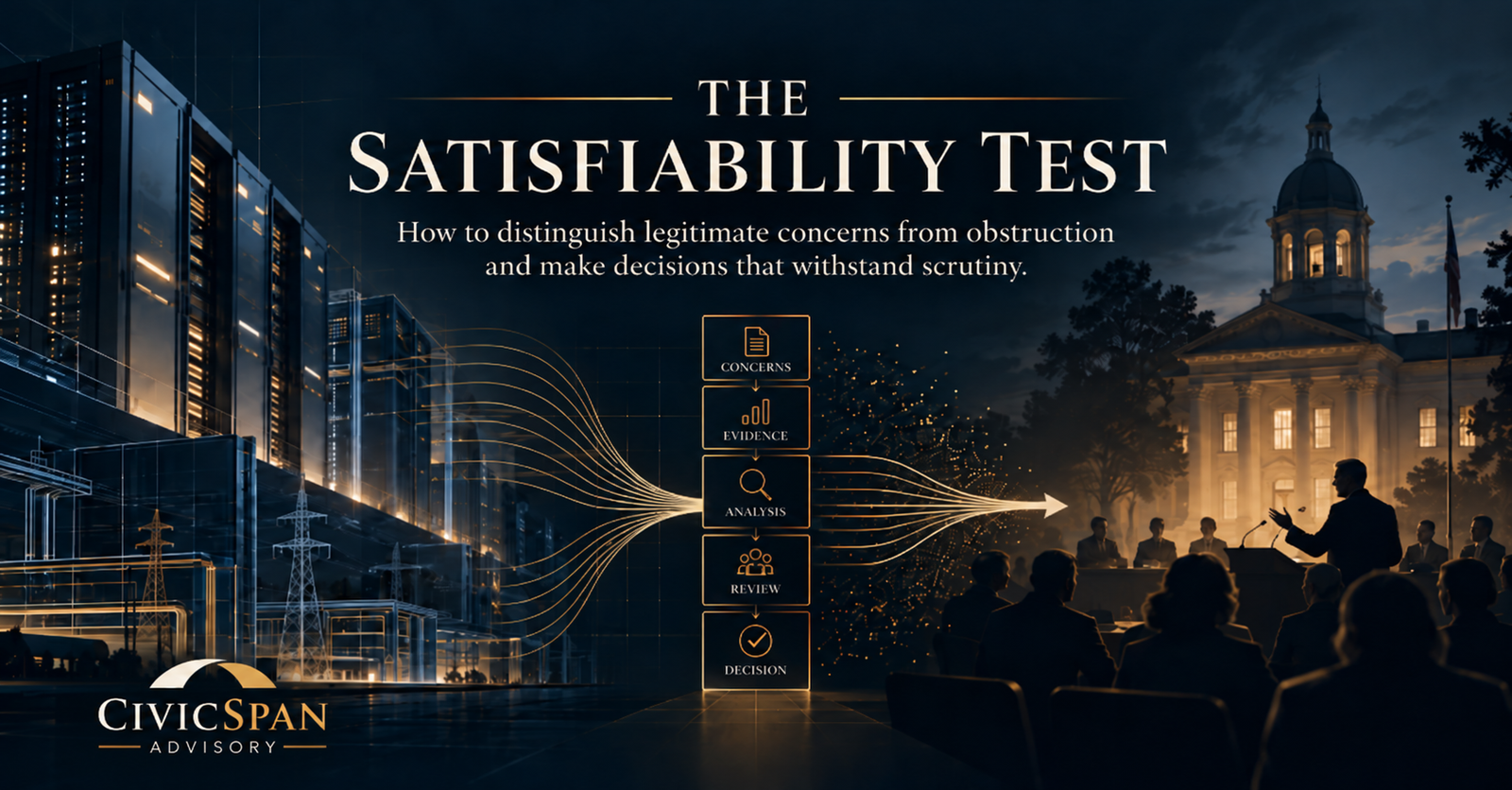
What separates a NIMBY from what I call a BANANA (Build Absolutely Nothing Anywhere Near Anything) is satisfiability. A NIMBY can be satisfied. Worried about noise? Put in sound berms and landscaping. Worried about your well? It's a closed-loop system, and here's the signed water agreement. Most complaints can be engineered away with a little money and ingenuity.
A BANANA can't be satisfied, because the objection was never really about the noise or the water. That's the difference between opposition and obstruction. Opposition asks hard questions and wants good answers. Obstruction is sabotage with a lawn sign.
A moratorium is a BANANA tool. It doesn't ask whether a project can meet the bar. It refuses to let anyone try. And the people who notice first aren't the residents. They're the developers.
Site selectors don't choose locations based on vibes. They work from spreadsheets full of risk, and the biggest risk on the sheet is entitlement risk: will the rules change after I've spent millions on land, engineering, and utility studies? A moratorium answers that question for them. Yes. Yes, they will.
Every developer keeps a risk register, whether they admit it or not. Once your town lands on it, you're not only off the list for data centers. You're off the list for the manufacturer, the logistics hub, and the food processor too.
Capital is a coward. It goes where it's welcome, and it doesn't send a thank-you note to the places it skipped.
Listen closely at these hearings and a lot of the anger isn't about the building. It's about what's inside it. AI feels like a black box coming for jobs, privacy, and a way of life.
I understand that fear, but AI is a tool. In my own field, securing water and power systems, it's going to help us use energy more efficiently, do math humans don't have time to do, and defend against attackers. It should never be the one making decisions that affect people. It can be a heavily scrutinized, trusted advisor, but a human still flips the switch.
And whether we build AI at all is a question our adversaries have already answered for us. They're building it, which puts us in a trap where we have to build it too or watch it be used against us. It's the nuclear arms race again. I'm old enough to remember crouching under my desk during civil defense drills, and I'd rather not see a sequel.
In The Cloud Has Hit the Ground, I argue that a data center at modern AI scale isn't an office park. It's closer to a shipyard. The shipyards of the last century didn't just build ships. They built a nation's ability to project power across the globe, and the towns that hosted them got stronger for it. Compute is that capability now.
Our adversaries understand this. They are building AI infrastructure fast enough to close the gap quickly, and make no mistake: they will use that compute to project their national interests around the world, economically, militarily, and in cyberspace. I spend my days on water and power security. When most people hear "hackers," they picture a teenager in a hoodie in his mom's basement. That's not who's in our networks. It's well-funded nation-state actors.
Almost every national leader agrees this infrastructure needs to be built. But when every community says "somewhere else," that somewhere else is increasingly in countries that don't like us very much.
The most common objection deserves a straight answer: yes, AI and automation will eliminate some jobs. I just built a new website with an AI model for the cost of a monthly subscription. A few years ago that would have cost me tens of thousands of dollars. That's real, and I won't pretend it isn't.
But economists have had a name for this for more than 80 years: creative destruction. Old jobs disappear, new ones emerge, and over time the new ones tend to outnumber the old.
I grew up in a small farming community in Illinois, so I don't have to look far for proof. In 1900, about 40 percent of American workers were in agriculture. Today it's probably about 2 percent, and American agriculture still feeds the world. Those farmhands' grandkids became electricians, millwrights, mechanics, and engineers.
The ATM tells the same story. When cash machines arrived, everyone knew bank tellers were finished. Instead, ATMs cut the tellers needed at a typical urban branch from about 21 to about 13, which made branches cheaper to run, so banks opened more of them and total teller employment grew. The job itself shifted from counting bills to managing customer relationships.
It's happening inside the data center industry right now. At DCAC Live in Austin this year, someone raised a concern about robots now doing floor layouts. Kirk Offel, CEO of OVERWATCH , answered it perfectly: somebody has to build the robot, and somebody has to maintain it. You lost one job but created four new ones.
There is a catch, and it's the one communities are right to worry about. The new jobs don't automatically land in the same town. A lot of those farmhands' grandkids had to leave home to find them. But follow that to its conclusion. If the new work is in building, powering, cooling, securing, and maintaining this infrastructure, where do you want it? Here, or three counties over? Ban the data center and you don't stop creative destruction. You just guarantee your town gets the destruction while somebody else gets the creative part.
Critics point out that only about 50 people might badge through the gate every day, and that's true. But look at the ecosystem around the building: HVAC techs, electricians, pipefitters, fiber crews, controls technicians, cybersecurity analysts. A large campus is a three-to-five-year build that keeps every contractor in the county busy, and every five to seven years the entire inside gets replaced in a tech refresh.
A data center is an electrical animal, and without electricians it doesn't get built. That's the kind of job that keeps a young couple buying a house in town instead of renting a U-Haul. If you want more of those jobs, write them into the deal: funded apprenticeships, trade programs at the community college, and veteran transition pipelines, with dollar amounts and deadlines attached.
Small towns are either growing or dying. There is no such thing as the status quo. The real alternative to a data center isn't a pristine cornfield forever. It's the school consolidation, the empty storefronts on Main Street, the water system nobody can afford to replace, and the kids who leave and don't come back. "Wait and see" has a cost. You just don't get an invoice for it.
So write the rules, not the ban.
Elk Grove Village, Illinois, shows what that looks like over the long haul. It has 20 data centers operating and 19 more in the pipeline, the second-highest concentration in the country behind Northern Virginia. The tax revenue was strong enough that residents received $400 credits on their water bills and $400 Visa gift cards. It isn't free of controversy, and hundreds of residents have packed town halls with hard questions. But the mayor shows up with the numbers and answers them.
At DCAC Live, I heard an industry prediction I think is exactly right: moratoriums will give way to certification. Imagine an independent body, not the industry grading itself, rating projects on water, power, security, and community benefit, and giving each one an A, B, or C. Everybody understands a report card.
Developers, this cuts both ways. For 20 years, too many of you practiced the quiet build: secret negotiations, NDAs, and the public invited only for the ribbon cutting. Americans have seen that movie, and they're not buying tickets anymore.
Festus, Missouri, shows what happens when you keep playing that game. The developer had already been run out of St. Charles County, and the lesson it apparently took was to say less. The secrecy filled with rumors, and Sunshine Law requests later turned up officials describing their own residents in derogatory terms. The whole episode turned a town full of NIMBYs into a town full of BANANAs. Now Festus sits on every developer's risk register, and it will stay there long after this fight is over. Nobody will hold a press conference to announce they passed on Festus. They'll just quietly take their projects somewhere friendlier.
Some confidentiality on the land purchase makes sense, since nobody wants to set off a speculation frenzy in a small town. After that, show up. Not at a town hall, but at the diner, after church, at the hardware store. Bring a single page with your water numbers, your power numbers, how you cool the building, and what the project means for the school district and the city budget. I heard a Microsoft developer say it himself at DCAC Live: the NDAs are killing us, and everybody knows what's in these buildings anyway.
Testifying before a House Small Business subcommittee in January, Chris Crosby of Compass Datacenters described a community meeting where people walked in wearing "No Data Center" stickers. By the end of the conversation, a lot of them had peeled them off.
That's governing. A moratorium is just governing's out-of-office reply.
So the question in front of small communities isn't "data centers, yes or no?" It's "on what terms?" Fight about the terms. Fight about how the money gets spent. Show up at planning commission and demand the best possible deal for your town. That's a fight worth having.
The communities that can answer "on what terms" are going to land the investment. The ones that can't will get a lovely, uninterrupted view of what might have been.
I'm not pro-data center or anti-data center. I'm anti-bullshit. And banning the future by ballot for a decade is grade-A bullshit.
What's your community doing? I'd genuinely like to hear from the mayors, utility directors, and commissioners working through this right now.